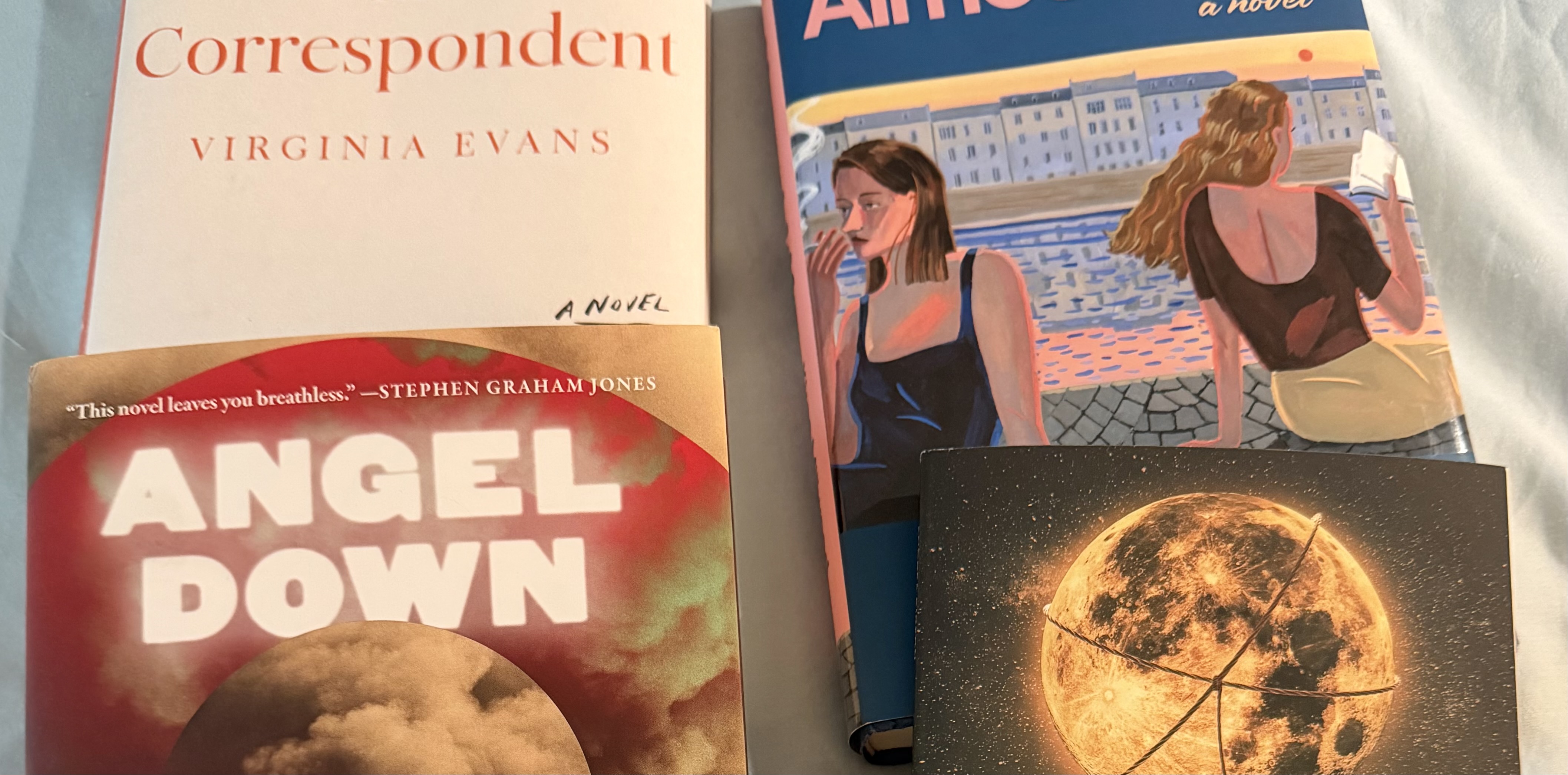
When we have to stay where we are, reading gives us some place to be. It began to rain in my neck of the woods last Thursday, May 21st. As I write on Tuesday morning, May 26th, it is still raining. A major drought now covers 70 percent of the West, so I can’t complain. I also can’t complain because I got in a lot of reading. Following are four books to consider for your own summer reading. I have read all of them and each one is an accessible, fascinating and inspiring read.

The Correspondent by Virginia Evans
This novel is about a prickly, sharp-witted 73-year-old, Sybil Van Antwerp [not Sharon J. Anderson] whose story revolves around Sybil’s daily ritual of writing letters. Recipients include family, friends, famous authors, and a troubled young mentee. An excerpt:
“Imagine, the letters one has sent out into the world, the letters received back in turn, are like the pieces of a magnificent puzzle, or, a better metaphor, if dated, the links of a long chain, and even if those links are never put back together, which they will certainly never be, even if they remain for the rest of time dispersed across the earth like the fragile blown seeds of a dying dandelion, isn’t there something wonderful in that, to think that a story of one’s life is preserved in some way, that this very letter may one day mean something, even if it is a very small thing, to someone?”
Almost Life by Kiran Millwood Hargrave
This novel is a sweeping, decades-spinning novel about Erica and Laure, two women who meet in Paris in the 1970s. It is beautifully written and completely heartbreaking. Some excerpts:
On the finality of their connection:
“Some relationships do not resolve. They become part of how you understand yourself, not unfinished, just permanently present.”
On the nature of heartbreak:
“And don’t think my pain wasn’t real, or as bad as yours. It is the condition of the heartbroken to believe no one has felt as they have, ever in the history of the world.”

You Better Be Lightning by Andrea Gibson
Andrea Gibson was a queer poet who’s been called a “rock star of poetry slams.” They died at 49 on July 15, 2025 after being diagnosed with ovarian cancer four years earlier. It is very likely that no poet has been more honest and vulnerable. Some excerpts:
A poem entitled, “Instead of Depression”:
“Instead of depression try calling it hibernation. Imagine darkness as a nurturing cave in which you will be nurtured by doing absolutely nothing. Hibernating animals do not even dream. It’s okay if you can’t imagine spring. Sleep through the alarm of the world. Name your hopelessness a quiet hollow, a place you go to heal, a den you dug, Sweetheart, instead of a grave.”
A short poem entitled, “Good Grief”:
Let your heart break/so your spirit doesn’t.

Angel Down by Daniel Kraus
I never in a MILLION years thought that this World War I novel would enrapture me. Winner of this year’s Pulitzer Prize in Fiction, it follows a soldier who encounters a celestial being on the battlefield. Take this in: the whole thing is a SINGLE LONG SENTENCE, rambling through 285 blood-soaked pages. The only punctuation in this novel are commas. There are no periods. The first page:

And the last page:

Hear me loud and hear me clear: this is a tough read. Kraus doesn’t pull any punches describing injuries from howitzers and mortar shells in excruciating detail (blood, viscera and body parts). In the midst of all the mayhem, however, Kraus explores various versions of the angel in literature, art and the Bible. Reading this book is an experience I won’t soon forget. I could not put it down.
What’s on your summer reading list?


13 responses to “Summer Reading 2026”
As of 4:43 a.m., it’s STILL raining.🌧️☹️
Our area is still 8-12 inches below our annual rainfall.
Until the current occupant of the White House was inaugurated, I mostly read non-fiction. So, over the weekend, I also finished, “In the Heart of the Sea: The Tragedy of the Whaleship Essex”: https://a.co/d/01BOXeT4
It is a harrowing, gripping saga of survival at sea but not for the faint of heart. When you’ve had nothing to eat for weeks, you resort to extreme measures.
[But this tragedy kind of pales in comparison to the news I just read that Paxton won the Republican nomination for Texas senator. Back to more fiction for me to escape this troubled world.]
Another book of poetry I just finished which was gifted to me by Beth: “Hard Listening” by Alison Luterman: https://a.co/d/00YTLNot
An excerpt from “Cloudburst” about two little girls in the poet’s neighborhood:
They are twin warrior-queens who rule this joint,
and I’m just a graying shadow, like most adults.
Their smiles gleam
like undiscovered galaxies. Oh fierce
and fiery girls, go forth and eat the world.
You can start with me if you want.
Unbeknownst to many, my “religion” has made a hard turn into Celtic wisdom and theology thanks for my friend, Carol, who knows how much Celtic wisdom is rooted in nature and the earth and how they heal the world.
I recommend, “Sacred Earth, Sacred Soul”: Celtic Wisdom for Reawakening to What Our Souls Know and Healing the World” by John Phillip Newell — https://a.co/d/08jbXw0Z
And “Anam Cara: A Book of Celtic Wisdom” by John O’Donohue — https://a.co/d/0cRSpUCp
Ironically, one of the characters on the hit series, “The Pitt” — Dr. Frank Langdon who had been hooked on drugs he surreptitiously stole from patients, quoted from this book this season. I assume it was recommended reading in his 12-step program. Celtic wisdom is applicable to all challenges of life.
Loved The Correspondent! Realized in reading it, how much we have lost, personally and culturally these days, by resorting almost exclusively to text and other “quickies” for communications with significant, or even not-so-significant, others. But can we ever go back? I WISH!
Preach it, sister!
And sadly, I don’t think we can over go back to personal missives the messages of which are not auto-generated. I pride myself on sending snail mail thank-you notes and condolences.
You are WAAAAY too deep for me dear friend though I admire your courage and your ability to read the hard stuff. I want escape literature. Life is too hard for me to read about hard life.
PS I know John O’Donohue. Have him on my bookshelf and read him for comfort as I can. I am willing to try the John Phillip Newell book.
Thanks for being YOU.
“Life is too hard for me to read about hard life.”
A very honest admission, Charlotte. It made me wonder if I read hard and dark books to make my life look less hard and dark in comparison. Probably.😬
Charlotte — you inscribed the 2026 desk calendar you gave to me this Christmas (and for every Christmas since 1979 — 47 years!) with the Andrea Gibson poem, “Instead of Depression.” I loved it then and still do. Love you, too!❣️🙏
About “Angel Down” . . .
After reading dozens of glowing reviews of this Pulitzer Prize winning novel, I bought it. When I opened it and saw that the story was ONE 285-page SENTENCE, with every paragraph beginning with “and” without any punctuation other than commas, I set it aside. “Why did I waste my money?” I thought.
But I had read Kraus’ last book, “Whalefall” about a scuba diver who has been swallowed by an 85-foot sperm whale and loved it. It was fast paced and heart pounding. https://a.co/d/0cq0RPpK
So I decided to give “Angel Down” another try. If I didn’t like the first 4-page chapter I wasn’t going to waste my time reading it. I set the book down after reading 84 pages and wondered if I had enough time to finish it. I didn’t at that time, of course, but it is an addictive, stunningly original book.
Adrienne asked me earlier today if “Angel Down” was based on a true story. I rather snidely responded, “Adrienne, it’s FICTION.” Then I realized she might be onto something.
Given the horrors of WWI trench warfare, who’s to say that celestial beings did NOT make battlefield appearances? This book may be fiction, but a huge part of me hope that they did on some level.
Wendy, my high school friend (that’s 56 years!) emailed this comment to me:
I loved The Correspondent! Just put a hold on Almost Life with our library system, so it should come to me in a few days. I don’t think I could stand the non-punctuation of Angel Down, and you know how I feel about what you and the rest of the world call poetry. However, I did love “Instead of Depression” and would call it a mini-essay, not a poem. I have a hold on Ellen Burstyn’s book, “Poetry Says It Better: Poems to Help You Wake Up.” I think it’s going to be actual poems, from what I’ve read. I’m interested to see what she’s chosen.
I’m currently reading The Things We Never Say by Elizabeth Strout, because I read all of hers. She wrote Olive Kitteridge, which was made into a TV mini-series or something, with Frances McDormand. I’m also reading and really enjoying The Last Kings of Hollywood – Coppola, Lucas, Spielberg and the Battle for the Soul of American Cinema. I think you’d like it. Also have Kent State: An American Tragedy. I’ve read a lot about this event already, since it’s right here in our county, but this book is supposed to include interviews with some of the National Guardsmen, who were for the most part just scared boys. So I thought it would be interesting to read their viewpoint. Also have two other books of fiction sitting here waiting and have holds on many more library books, including two non-fiction: The Best Dog in the World – Essays on Love, and David Sedaris’s The Land and Its People. Couldn’t stand Yesteryear, which is on bestseller lists and some reviews are loving, so didn’t bother reading past the first couple chapters. There’s too many good books out there to waste time on something I’m not liking.
Too bad Wendy doesn’t like to read . . .
RE: the Andrea Gibson poem, “Instead of Depression” . . . I did not copy it into my post like it appears in the book because I don’t know how to make line breaks in the WordPress post thingy. In the book, that poem looks like this:
Instead of Depression
try calling it hibernation.
Imagine the darkness is a cave
in which you will be nurtured
by doing absolutely nothing.
Hibernating animals don’t even dream.
It’s okay if you can’t imagine
Spring. Sleep through the alarm
of the world. Name your hopelessness
a quiet hollow, a place you go
to heal, a den you dug,
Sweetheart, instead
of a grave.