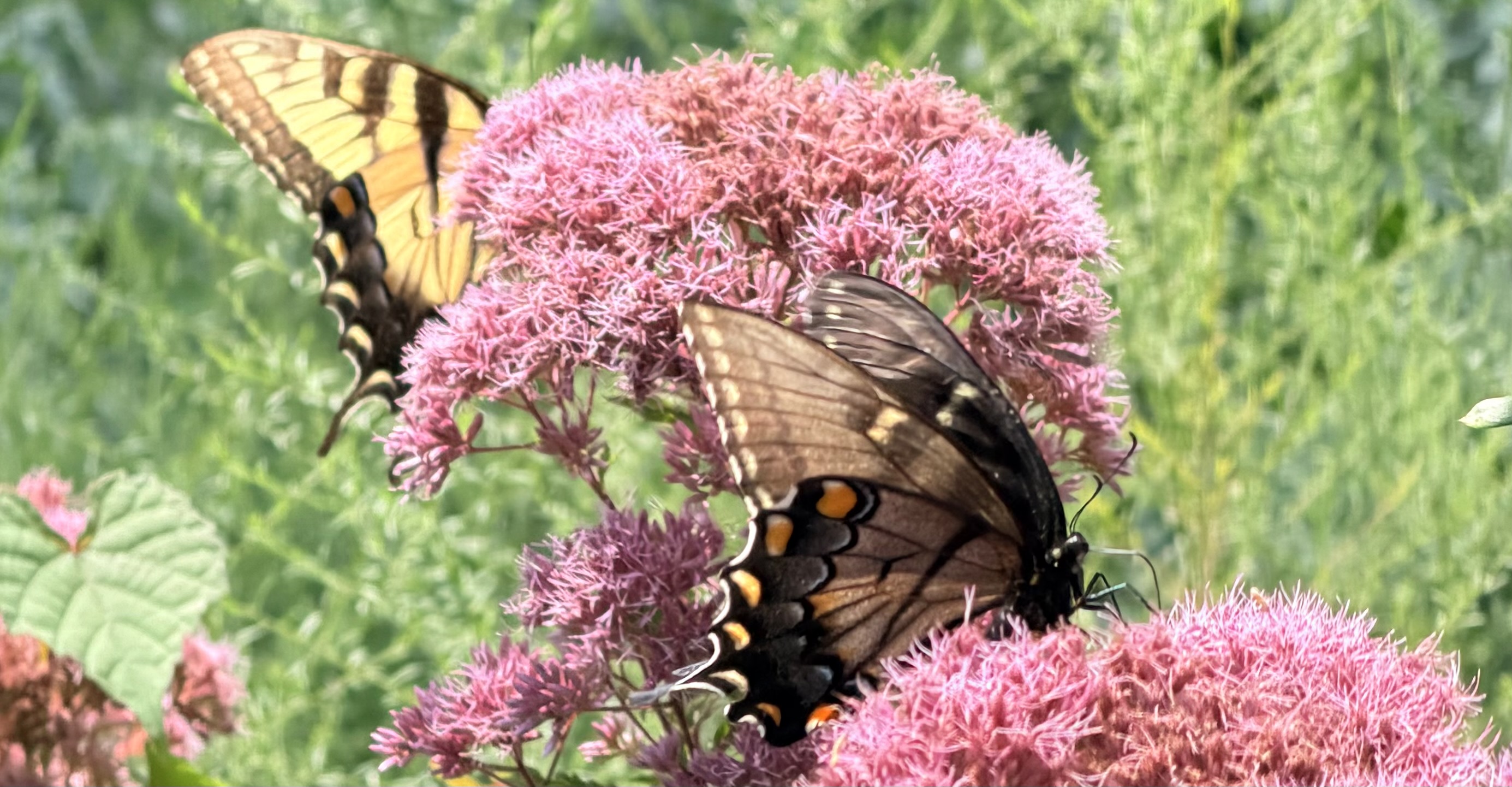

Two and a half years ago, I invested in a skilled horticulturist to transform my front yard into a haven for pollinators. Last year, I had several visitors, including hummingbirds.

I also had bees and many varieties of butterflies, but this year, I saw something I had never before seen in my front garden: Monarch caterpillars.


I saw them for three days and now they are gone. The life cycle of a monarch butterfly has four main stages: eggs from an adult Monarch which last about 3-5 days before hatching on a milkweed plant. The caterpillars last about 9 to 14 days as they eat milkweed and grow (see above photos). They then become chrysalises (none as of yet that I can see) that last for 9 to 14 days before emerging as adult butterflies. They live for only two to five weeks which seems sadly short, but perhaps the real joy is that each mating event lasts up to 16 hours, from one afternoon until the next morning.
Although I have seen adult monarchs (which are orange), I’ve never been able to see them long enough to take a photo. The yellow swallowtails, on the other hand, are quite the showoffs in my garden.


Maya Angelou has said, “We delight in the beauty of the butterfly, but rarely admit the changes it has gone through to achieve that beauty.” My garden butterflies have taught me a lot about transient beauty and appreciating fleeting moments. But perhaps they have also taught me that the many changes I have gone through have achieved a beauty I cannot always see. Add to that Mary Oliver’s words from the last stanza in her poem, “One or Two Things,” and I’m reminded that in the grand scheme of things, small failures will fade away.
For years and years I struggled
just to love my life. And then
the butterfly
rose, weightless, in the wind.
“Don’t love your life
too much,” it said,
and vanished
into the world.


12 responses to “Build Your Garden and They Will Come”
This is officially the 300th post I’ve published on Spark and Spitfire. The first one was published on June 20, 2020 — more than six years ago. It’s been an uneven run, but I still show up which at my age (or any age, for that matter) is a small miracle.🙏
Two things: PBS is airing an “American Masters” episode tonight about Mary Oliver. It airs at 9 pm EST in the DC area market. Check your local listings if interested.
AND, today marks my beloved Beth’s birthday. HAPPY BIRTHDAY, to BETH and her wild and precious life. 💕🎂
Thank you! What a perfect birthday post as there’s a lot of “transformation” happening in my life. This birthday will be more work than play as the movers come tomorrow to move the furniture and heavy boxes from our house of 40 years to our “new” one. It is hard work and a pure delight!
“Hard work and a pure delight!”
Completely describes how you live life, Beth. Congrats on your new home. You and Paul have earned it.❤️
Wow! Happy birthday to one of my favorite humans! This feels like the type thing that seems like something I should be helping with, helping with moving one of the most giving and loving people I know. Instead I’ll send some energy and love and prayers to you and in your honor, try not to feel guilty for not doing more. I love you Beth ❤️
Cannot wait to see the MO film! xo
How grateful I am to see your name and words here, Lesa!🙏❤️
Stubbornly determined, I stood in my front yard at various times yesterday to see if an actual Monarch butterfly (orange) would show up. Alas, just yellow swallowtails wanting another moment in the limelight.😕
300 posts and butterflies! You are so cool, my beloved friend. Thank you for creating a space where we can be together.
Thank you, Neola, for tirelessly inspiring this space.🙏💕💕💕💕💕
What a gift your garden is to so many–to you, your neighbors, to us readers of your blog, to our environment, to the endangered monarchs, and I suspect to many other critters as well. Thank you, & thanks for the interesting research you shared.
Thanks, Carol. I hope I didn’t come across as a know-it-all, because I know so LITTLE about botany and critters and such. As a matter of fact, when I first saw the caterpillars, I had no idea how they got there. Who made them? Did some bird drop them there for safekeeping? Then I did some research and saw that they came from an egg, etc. What fascinated me most was how short their lives were. How old are the ones that migrate from South America? How do they do THAT?! Back to Google!💕