Annie Dillard, the Pulitzer-winning author of Pilgrim at Tinker Creek, died Tuesday. She was 81. Her obituary in the Washington Post, described her as a “bard of the environment, a 20th-century Henry David Thoreau, a youthful sibyl of the wildwoods, a visionary whose shimmering prose offered glimpses of the eternal.” The New York Times obituary describes her “as a young American writer [who] walked into the woods and came out with a Pulitzer Prize-winning book on the wonders and horrors of creation, the modern classic “Pilgrim at Tinker Creek.”


I loved Annie Dillard’s writing and my journals are filled with quotes from her books. In Teaching a Stone to Talk, Dillard related the story of a man who shot an eagle out of the sky and when he found it, the dry skull of a weasel was fixed by the jaws to the eagle’s throat. Dillard’s lesson here is recorded in one of my journals:
I think it would be well, and proper, and obedient, and pure, to grasp your one necessity and not let it go, to dangle from it limp wherever it takes you. Then even death, where you’re going no matter how you live, cannot you part. Seize it and let it seize you aloft even, till your eyes burn out and drop; let your musky flesh fall off in shreds, and let your very bones unhinge and scatter, loosened over fields, over fields and woods, lightly, thoughtless, from any height at all, from as high as eagles.

Several of my beloveds knew of my love of Dillard and gifted me with a couple of her books. This is the inscription in An American Childhood:


One of my favorite passages from Pilgrim at Tinker Creek:
The world has signed a pact with the devil; it had to. It is a covenant to which every thing, even every hydrogen atom, is bound. The terms are clear: if you want to live, you have to die; you cannot have mountains and creeks without space, and space is a beauty married to a blind man. The blind man is Freedom, or Time, and he does not go anywhere without his great dog Death. The world came into being with the signing of the contract. A scientist calls it the Second Law of Thermodynamics. A poet says, “The force that through the green fuse drives the flower/Drives my green age.”* This is what we know. The rest is gravy.
I learned of Dillard’s death from Adrienne, who called knowing that I would be saddened. One of the things I told her was what I’ve been telling her for the last several weeks, “The wrong people are dying.” Dolly Parton, Wendell Berry, Gloria Steinem, Robin Morgan . . . .” And now, Annie Dillard. With all apologies to this late visionary, the great dog Death has come for the wrong people. This is what I know. The rest is not gravy.

*From the poem, “The force that through the green fuse drives the flower” by Dylan Thomas
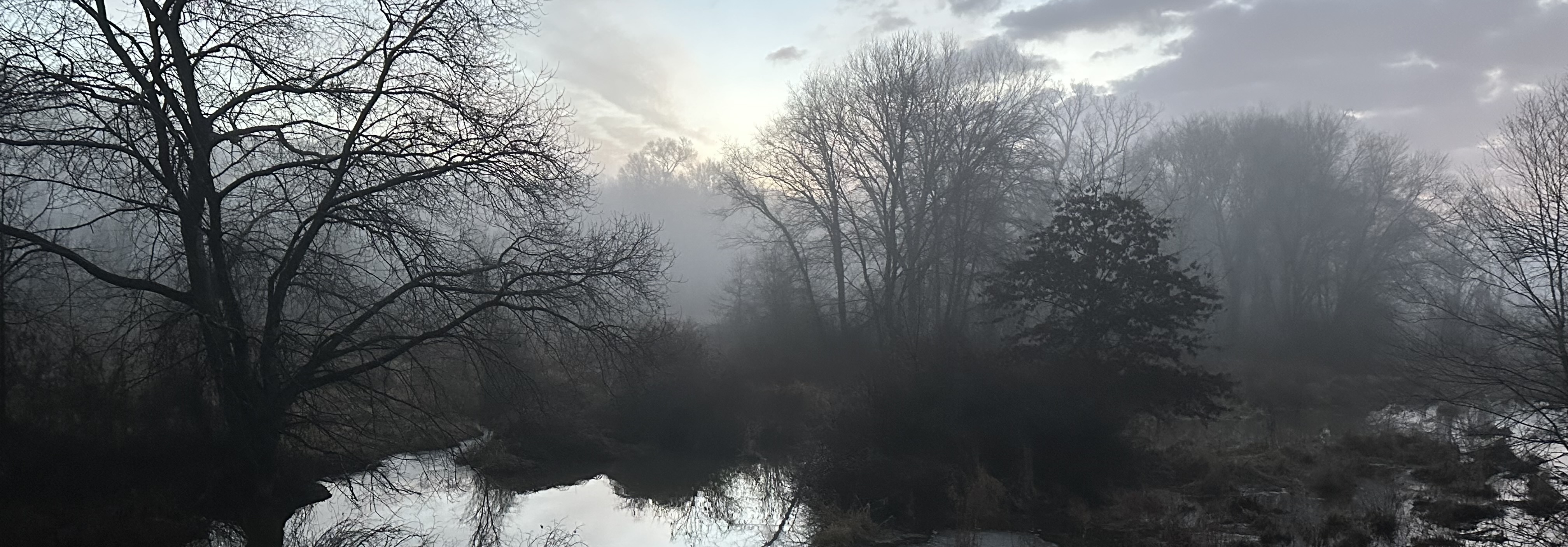
The top post photograph (like the other photos in this post) is of Beaver Dam Creek — my Tinker Creek — February 2025.


12 responses to “A 20th-Century Thoreau”
An Annie Dillard perspective that I now apparently live by:
“I worked so hard all my life and all I want to do now is read.”
I was the first to tell my pastor yesterday because I notice he quotes her poems often. So much for deaths coming in 3s – this has been an uncanny list. If we didn’t love we wouldn’t care though, so let’s keep grieving and risking to love anyway.
I wasn’t surprised to see your comment, Trish, because I had a hunch you appreciated Dillard. Head hanging low, I remember browsing through her book of poetry in a bookstore several years ago, and not particularly liking the poems. I also could not finish The Maytrees — a novel. You have to share a Dillard poem if you can find one.
“Let’s keep grieving and risking to love anyway.” Very wise. Not easy, but very wise. Thank you.
Atlantic’s tribute to Dillard included this perspective from her:
“At a certain point you say to the woods, to the sea, to the mountains, the world, Now I am ready,” she wrote in 1981. “You feel the world’s word as a tension, a hum, a single chorused note everywhere the same. This is it: this hum is the silence. Nature does utter a peep—just this one.”
In farmland, I hear this silence.
Beautiful tribute. I have no words. Only my heart.
Thank you, Charlotte 🙏❤️
A passage I loved from “The Writing Life:”
“There is no shortage of good days. It is good lives that are hard to come by. A life of good days lived in the senses is not enough. The life of sensation is the life of greed; it requires more and more. The life of the spirit requires less and less; time is ample and its passage sweet. Who would call a day spent reading a good day? But a life spent reading — that is a good life.”
I’ve noticed that with each of these significant deaths, like Dillard’s, that I notice the age and compare it to my own. She was 81 and I think, “Well, I may have 10 more years, if I’m lucky.” Surely, that is a sign that I should strive for more good days in the life of the spirit. There is a Buddhist teaching, “Do not waste this precious life.” Indeed, it feels more precious by the day.
Thank you, Beth, for taking the time to share this passage from, “A Writing Life.” It reminds me that I have had a good life.
I have been doing the SAME math in my head when these folks have died: “Oh, wow, Dolly dies at 80. I have less than seven years to get my shit together.”😐 Not exactly “in the life of the spirit,” but at least I’m cognizant of fleeting days. Interestingly, I am watching less and less TV and reading more and more. Also resurrecting projects here and there, and believe it or not, missing the Eucharist. (Long story. Look for details in future posts.) It is all a bit bewildering to me, but I’m playing along.
I am here. I am still witnessing.
I am reading this at 3:42 a.m., Friday, September 18, Neola, and am filled with gratitude that we remain connected and a witness to each other after—what is it—20 years?❤️🙏
A beautiful tribute to a remarkably profound life spelled out in such depth and clarity in her writings. I have to say, dear Friend, that I think you are very much a kindred spirit with this woman, in the depth of your feelings about all things: happy and sad, beautiful and ugly. Not much escapes you. Not much is “trivial” to you, as you are so present to all that is going on around and within you: the painful and perplexing as well as the beautiful and clear. Hope/believe you will be this you to the very end.
Also reading this early Friday morning, September 18, Carol. Actually, reading and re-reading it. Thank you for naming once again what I have always struggled to see in myself. It continues to be inspiring and life-giving.🙏❤️